
Hey, my lovely gamers! 💜✨
Have you ever played a game where a shopkeeper remembered something you did and thought, “Wait, how did they do that?” I love those little moments. Lately, though, I’ve seen the word AI used for everything from how an enemy chases you to how a studio might create its artwork. Those are different questions, and they matter for different reasons.
A ghost taking a clever shortcut can be following rules a designer wrote decades ago. A tool that drafts a new line of dialogue is doing something different. And neither example tells us who painted the background or composed the music.
🧠 What does AI mean in a video game?
Artificial intelligence is an umbrella term for systems that perform tasks such as recognizing patterns, making predictions, solving problems, or choosing actions. Machine learning is one approach to AI. It uses data to train a model. In games, developers can also write rules that tell a character when to patrol, chase, retreat, or attack.
Imagine a guard who follows a route until you step into view. The guard spots you, gives chase, and eventually returns to patrol. A developer can build that whole encounter with rules and a few pieces of information about what’s happening in the game. The guard’s behavior can feel clever even if it follows the same rules every time.
🎨 What makes AI generative?
Generative AI produces outputs such as text, images, music, video, or code. Modern generative models learn patterns from training data and use those patterns to produce an output in response to input. That output can be surprising, familiar, or wrong. The ability to generate it tells us little about where the training material came from or whether an individual result is original.
Think about the guard again. A game can select a line a writer wrote when you reach the gate. A language model could instead compose a reply when you ask the guard a question in your own words. Both versions can react to you, but the dialogue comes from different places. A single game could use both approaches.
IBM · What is generative AI?Google Cloud · When to use generative AI or traditional AI
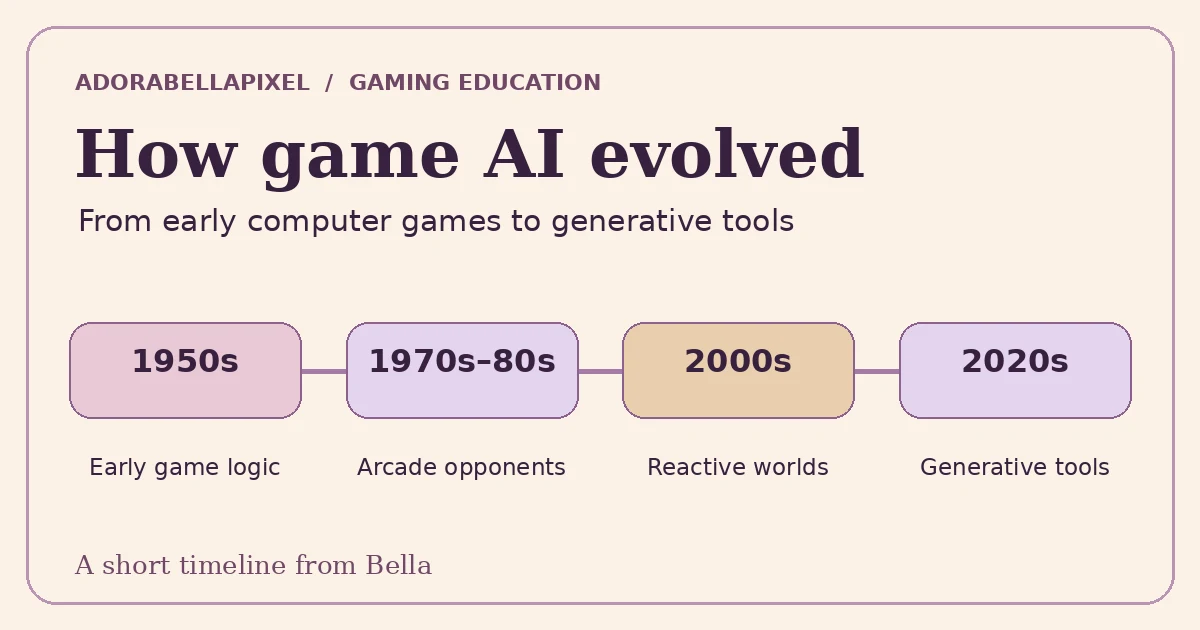
👾 A short history of game AI
Early computer games gave engineers a way to show how programmed machines could play against people. By the arcade era, designers were using readable movement and attack patterns to make opponents feel distinct. I love that some of those simple ideas still work so well today.
- 1950s · Early computer games
- The Nimrod computer demonstrated the strategy game Nim in 1951, and OXO brought tic-tac-toe to the EDSAC computer in 1952. Both illustrate how early computers could play within a defined set of rules.
- 1970s · Arcade opponents
- Space Invaders made waves of moving enemies feel threatening through programmed patterns and escalating pressure.
- 1980s · Pac-Man’s ghosts
- Blinky, Pinky, Inky, and Clyde use different targeting rules. The ghosts look like they have personalities because the rules put different kinds of pressure on the player.
- 1990s · Strategy and navigation
- Real-time strategy games gave computer-controlled units more jobs, from moving through crowded maps to responding to orders and threats. Pathfinding helps a unit get around obstacles along the way.
- 2000s · Reactive worlds
- Valve’s Left 4 Dead AI Director varies the pacing of encounters in response to the team’s gameplay. It can give players room to catch their breath between tense moments.
- 2020s · New tools in the workflow
- Studios can use generative models for tasks like suggesting code or composing dialogue. A tool a developer uses while building a game and a model that produces content while you play are different uses, even when both are generative.
Computer History Museum · Graphics & Games timelineThe Strong · Space InvadersGame Developer · The Pac-Man DossierMichael Booth, Valve · The AI Systems of Left 4 Dead
💜 When an NPC seems to remember you
Picture a shopkeeper who remembers that you fixed the town bridge, offers a friendship discount, and greets you differently the next morning. The game can store a completed quest, track a friendship score, and choose a line based on both. A writer can plan every possible greeting.
Procedural generation is another term you’ll hear. A game might assemble a dungeon from room templates and placement rules, giving you a different layout each run. That’s one way to generate variety through code. Seeing a new layout, or hearing an NPC acknowledge something you did, tells you very little about how the studio made its illustrations, dialogue, or music.
🌸 Loftia and its fan-content policy
Qloud Games’ published policy asks fans to make their own creations when using Loftia’s intellectual property and forbids using any part of Loftia to train generative models. That gives fan artists and makers a clear answer about the work they share.
There’s also a separate statement about development. When someone asked about generative AI in art or code in Loftia’s Reddit launch announcement, the account posting on behalf of the Loftia team said it did not use AI in developing the game. That’s a public statement from the team. The fan policy covers fan work, and the launch-thread reply describes the team’s own practices. Neither source is an independent audit.
Qloud Games · Loftia fan-content policyLoftia team · Reply in the Early Access announcement thread
🦊 What Spry Fox disclosed about Spirit Crossing
In a developer response on Steam, Spry Fox said its policy bars AI-generated creative game content, including art, writing, music, sound, and game design. The studio also said some engineers and designers optionally use Claude for time-consuming repetitive work or codebase security. The developer described a requirement for experienced human review, editing, and accountability before material is incorporated into the game.
Those details are Spry Fox’s own description of its policy and process. They give players a concrete basis for asking whether their personal boundary applies to the creative content they encounter, the tools a studio uses behind the scenes, or both.
🎭 Why players and creators care
- Consent and compensation
- Artists may want to know whether their work was used in training, whether they agreed to it, and whether they received credit or compensation.
- Creative jobs
- A tool can save time on one task while changing how another job is staffed or valued. It matters who benefits, who makes the final decisions, and who is credited for the work.
- Transparency
- A player who cares about a game’s voice performances may want a different disclosure from someone who cares about code assistance. Naming the task and where the output ends up gives both readers more information.
- Artistic identity
- A consistent voice or a distinctive art style often comes from hundreds of small creative decisions. Players can care about who made those decisions and how the studio protects room for that work.
🔍 What a convincing output can tell us
A language model can write a confident answer that contains a mistake. It can also perform differently on an unfamiliar situation than on examples resembling its training data. Researchers can examine how models behave, though tracing the reasons for one particular output can be difficult.
A convincing line of dialogue is evidence that the system produced a convincing line of dialogue. Claims about human-like understanding or general intelligence require more evidence. The same goes for guessing how a game was made from a screenshot or a character interaction alone.
🌷 Where I stand
As a gamer and creator, I love finding the small choices people put into a world. The voice line that made me laugh, the shop window I stopped to screenshot, the music I still hum years later. I want the people who make those moments to be credited, and I want studios to be clear about the tools they use.
When a studio says it uses AI, I want to know what it does. Does it help an enemy find its way around a wall? Did it suggest code a developer then reviewed? Did it produce a character portrait before release, or does it write new lines while I play? Those answers let each of us decide what matters to us without guessing at someone else’s work.
I’m curious where you draw your own line. You can have different answers for a coding tool, an illustration, and a live NPC conversation. I’d love to hear what a clear and useful disclosure would look like to you.
💬 Let’s talk
What would you want to know before buying a game that uses generative AI? Would your answer change if the tool helped with code, created a finished asset, or wrote dialogue while you played? And which old game has an enemy or NPC you still remember because of how it behaved?
Share your thoughts in the comments. Please keep the conversation focused on the work and the policies, and give other players room to explain where they draw their own boundaries.
Stay cozy, stay curious, and keep supporting creativity! 💜
— Bella | AdorabellaPixel